| Our Projects | ||||
| Joseph Haydn String Trios |
J. Stamitz, Chr. W. Gluck Sinfonie a tre |
Joseph Haydn the Unknown |
Other Projects |
|
Johann Stamitz, Christoph Willibald Gluck: Sinfonie a tre
...The changes which lead from the musical Baroque to the Viennese Classical era were perhaps the most radical and comprehensive up to this point in music history, much more radical than those leading from the Renaissance to the Baroque era. While the latter can be seen mostly as an evolution where certain styles proved to be successful and became the new "standard", the new beginning heralded by the end of the Baroque era involved revolutionary compositional techniques whose surprisingly long life span reached at least to the end of the 19th century....
...It was without doubt Johann Stamitz who provided the incentive for this new orchestral style. He came to Mannheim around 1741 and soon took over the direction of the Mannheim orchestra. Although the idea that Mannheim invented the crescendo is certainly nonsense, it is nonetheless true that great dynamic contrasts, extreme crescendi and an incredible orchestral virtuosity were the trademarks of the Mannheim orchestral style, and this was achieved to a perfection which was described as unrivaled by contemporaries....
(Excerpt from the CD-booklet, Text by Johannes Gebauer)
Johann Stamitz: Trio (Sinfonia) in G minor
Christoph Willibald Gluck: Sinfonia in E
Johann Stamitz: Trio (Sinfonia) in C minor
Joseph Haydn: Concertino in G
Scoring (4): 2 Violins, Violoncello, Harpsichord
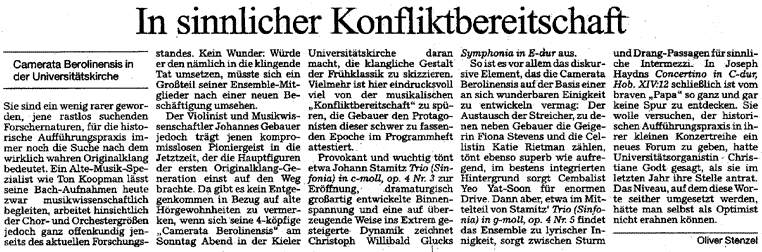
A CD recording of the works by Stamitz and Gluck, plus another trio by Gluck was released by Musikmanufaktur Berlin in 2003. Promotion CD available on request.
The Press:
Rare but wonderful 18th century chamber music, beautifully played.
This disc is essential listening for anyone interested in 18th century music. Camerata Berolinensis presents four never-before-recorded "sinfonie a tre" by two mid-18th century masters that are true gems. Those not always happy with "period instrument" recordings will find little if anything to complain about. In fact, these performances find a nearly perfect balance between energy and delicacy, style and virtuousity, scholarship and musicianship. The recorded sound is wonderful, with each instrument clearly audible but always in balance. In sum, this disc is highly recommended, and the more people who buy it and recommend it to others, the sooner we will hear more from this wonderful ensemble.
Wade Kotter at www.cdbaby.com